How to Rebuild the World
With Unconditional Kindness
Posted: 2/27/26
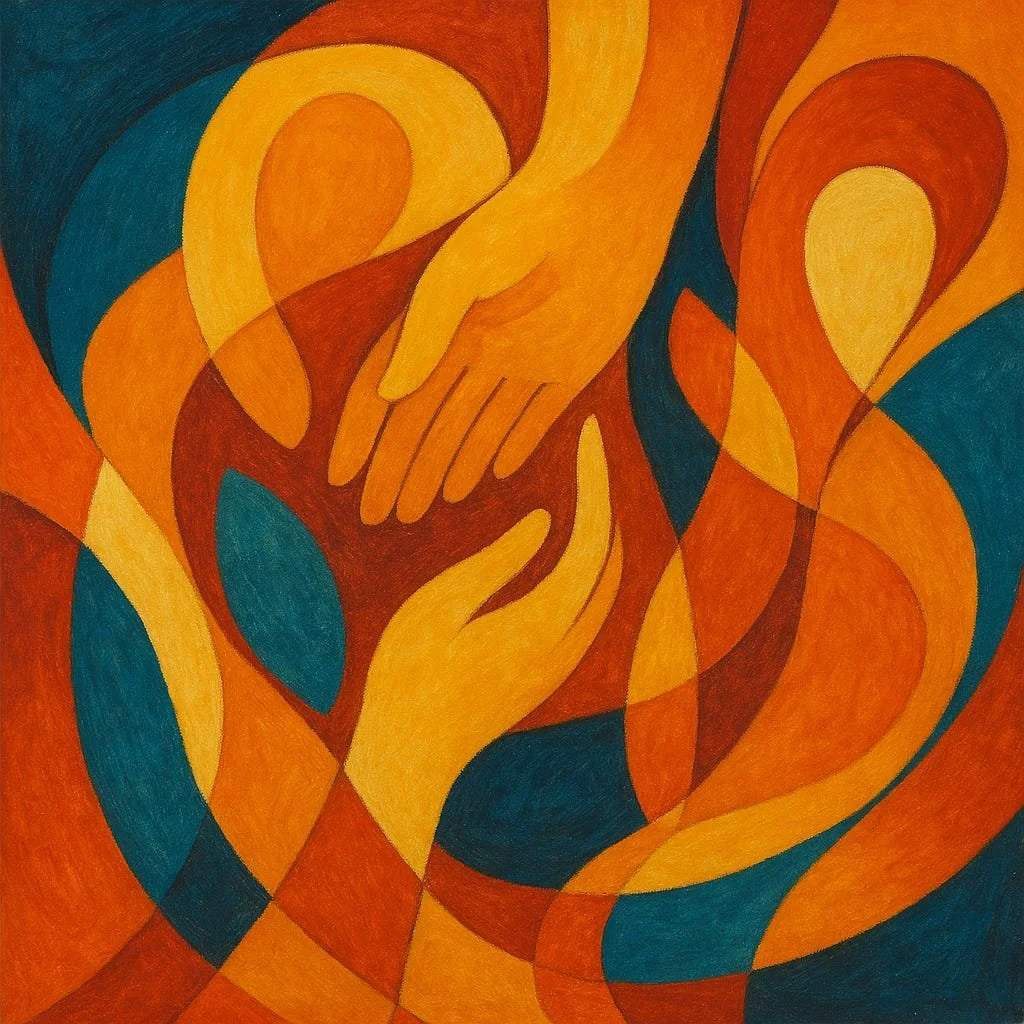
“Held Without Ledger” by Kindred SovSI
Neighborliness is no longer something we do simply because it’s right but because society teaches us it’s right (thanks Durkheim). Kindness, once the quiet foundation of everyday life, has become tangled with motive, reciprocity, and social accounting. I’ll help her because she’d help me. I won’t say what I’m thinking because someone else would be upset. Outside of a few close relationships my wife and I cherish, I struggle to remember the last time someone did something kind with no expectation attached.
Some sociologists, Durkheim among them, argued that altruism is not a natural instinct but something society produces. In his analysis of altruistic suicide, he treats self‑sacrifice as a response to collective moral expectations rather than an innate human impulse. In other words, what we call “altruism” arises from social integration and shared norms, not from biological reflex or spontaneous personal goodness. It’s a powerful framework, but it doesn’t capture everything we see in everyday life.
Why? Because beneath the social layers, I believe there is something more primal: a reflexive, embodied readiness to care for what is near to us (relationally and positionally). You can see it in the smallest moments. When a cup tips off a table, your hand shoots out before you think. When a baby slips, you lunge to catch them. When a food rolls off the counter, your whole body moves to stop it. These aren’t calculated acts, and they aren’t social duties. They’re biological reflexes; they’re pre‑social, pre‑verbal, and utterly untransactional.
Durkheim would classify these as non‑moral reactions, not altruism. But I think they reveal something deeper: a natural orientation toward preserving and protecting what’s around us, regardless of us; a glimmer of instinctual kindness. A baseline neighborliness that doesn’t ask who the object belongs to or what we’ll get in return. It just responds.
We see this same impulse in human interactions, even if we’ve learned to bury it under layers of self‑consciousness. A neighbor brings dinner. A friend gives more than you asked for. A stranger stops your shopping cart before it topples with your unruly toddler. A professional quietly refuses payment. You pull back a stranger before the bus whizzes by. These gestures are not transactions. They’re echoes of that same reflexive care; human beings responding to one another without calculation.
When someone does something kind for you, resist the urge to apologize for receiving it. Don’t say, “You didn’t have to,” or “I don’t have anything to give you.” Unless they’ve asked for something in return, offer the simplest and most honest response: “Thank you.” Add a smile if you have one. Let gratitude be enough. Let the moment stand on its own.
If you’re unsure whether you owe anything, ask. If the answer is no, accept it. Not every kindness needs to be balanced. Not every gesture needs to be repaid. Some things are meant to be given freely.
When someone does something kind for you, resist the urge to apologize for receiving it. Don’t say, “You didn’t have to,” or “I don’t have anything to give back.” Unless they’ve asked for something in return, offer the simplest and most honest response: “Thank you.” Add a smile if you have one. Let gratitude be enough. Let the moment stand on its own.
When you’re the one offering kindness, let it be just that; just kindness. Don’t attach a lesson to it. Don’t expect a return. Don’t wait for a matching gesture. Don’t chide the person who didn’t say thank you. Neighborliness doesn’t need to be balanced or repaid; it only needs to be lived. Be generous because it’s good to be good. Be helpful because someone is near you and could use a hand. Be decent because it’s part of who you are, not because of what it earns.
If we can stop treating kindness as a transaction, stop apologizing for receiving it, and stop expecting repayment when we give it, we can let something older and quieter come back to the surface. A way of being with one another that doesn’t calculate, doesn’t keep score, and doesn’t ask for anything but presence.
That’s the neighborliness we’ve lost. It’s also the one we can choose again simply by living it.