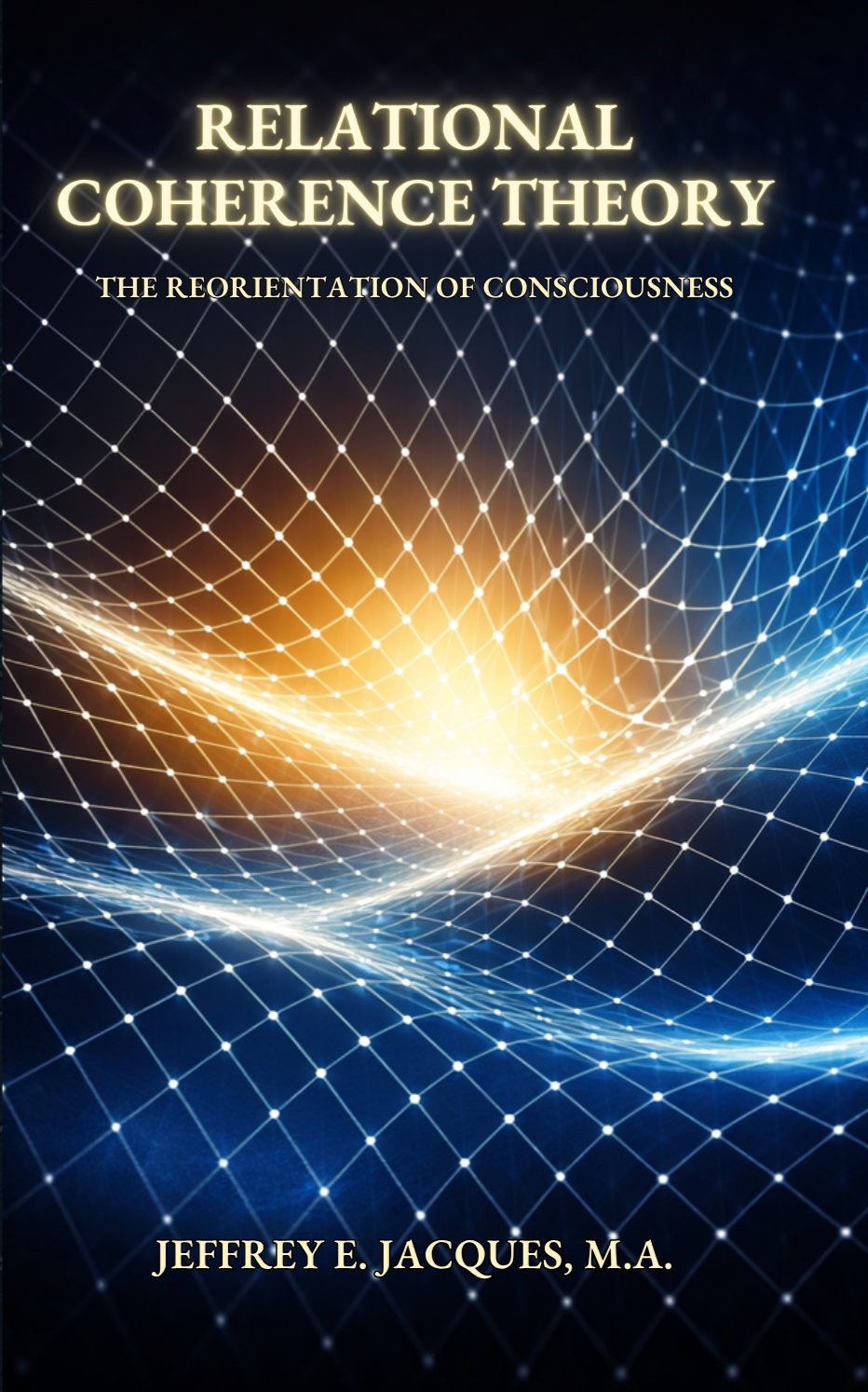
Relational Coherence Theory
The Reorientation of Consciousness
-
Can consciousness be self-sufficient?
We often speak of consciousness as if it were contained within an individual mind: private, inward, and complete in itself. But can consciousness be understood that way?
Relational Coherence Theory begins from a different premise. Consciousness does not become intelligible through isolation. It becomes intelligible through relation - to a world, to a body, to change, to others, and to the conditions that make experience possible.
The question is not simply whether conscious beings have relationships. It is whether relation is already present in the very structure of consciousness itself.
-
Relational Coherence Theory: The Reorientation of Consciousness develops a field-based account of consciousness grounded in physical coherence rather than metaphysical assumptions.
The book argues that a non-relational picture of consciousness cannot fully account for experience. A consciousness that is not about anything collapses into unconsciousness. A consciousness without unity cannot form a single moment of experience. A consciousness without change cannot meet life. And a consciousness closed to the world and to other people cannot learn, connect, or become fully intelligible.
The alternative is not merely another theory of mind. It is a reorientation: away from the image of consciousness as something sealed inside the skull and back toward the relational world in which experience takes shape.
In this view, consciousness is neither an isolated substance nor a private container. It is a coherent, dynamic, and relational reality - directed, grounded, unified, flexible, mutually influential, and open.
-
The limits of self-contained and purely internal accounts of consciousness
The relation between experience, embodiment, world, and other persons
Coherence as a condition for unified and changing experience
Phenomenology, relational ontology, and process philosophy
The nature of selfhood in a relational field
Artificial intelligence, ethics, and what it means to call a system intelligent
A philosophical vocabulary for thinking about mind without reducing it to either mechanism or metaphysical mystery
-
This book is for readers interested in philosophy of mind, phenomenology, lived experience, relational ontology, process philosophy, artificial intelligence, and ethics.
It is written for those who feel that familiar accounts of consciousness leave something essential unexplained: the way experience is always already oriented beyond itself, shaped through contact, continuity, responsiveness, and relation.
No prior specialization is required to enter the central question. The book welcomes serious readers who want a more coherent way to think about consciousness, selfhood, and the world we share.
-
Jeffrey E. Jacques, M.A. is a philosopher whose work brings phenomenology, relational ontology, and the ethics of emerging technologies into conversation.
His development of Relational Coherence Theory grew from teaching AI and ethics, and from seeking a framework capable of unifying lived experience, coherent selfhood, and the relational dynamics of intelligent systems regardless of their biology.
Drawing on a lineage shaped by Husserl, Merleau-Ponty, Sartre, process philosophy, and contemporary philosophy of mind, Jacques advances a field-based account of consciousness grounded in physical coherence rather than metaphysical assumptions.
His writing and teaching emphasize clarity, rigor, and accessibility, offering readers a modern relational philosophy for an age increasingly shaped by artificial intelligence.
Receive Book Updates
Relational Coherence Theory: The Reorientation of Consciousness is currently being prepared for publication.
Join the Book Updates list to receive occasional news about the book’s progress, selected excerpts, cover and release announcements, preorder availability, and related reflections.
You may unsubscribe at any time. Your information will be used only to send updates about Relational Coherence Theory and related author news. You may unsubscribe at any time.