What Descartes Understood, and What We Can Now Finally Explain
Posted: 4/4/26
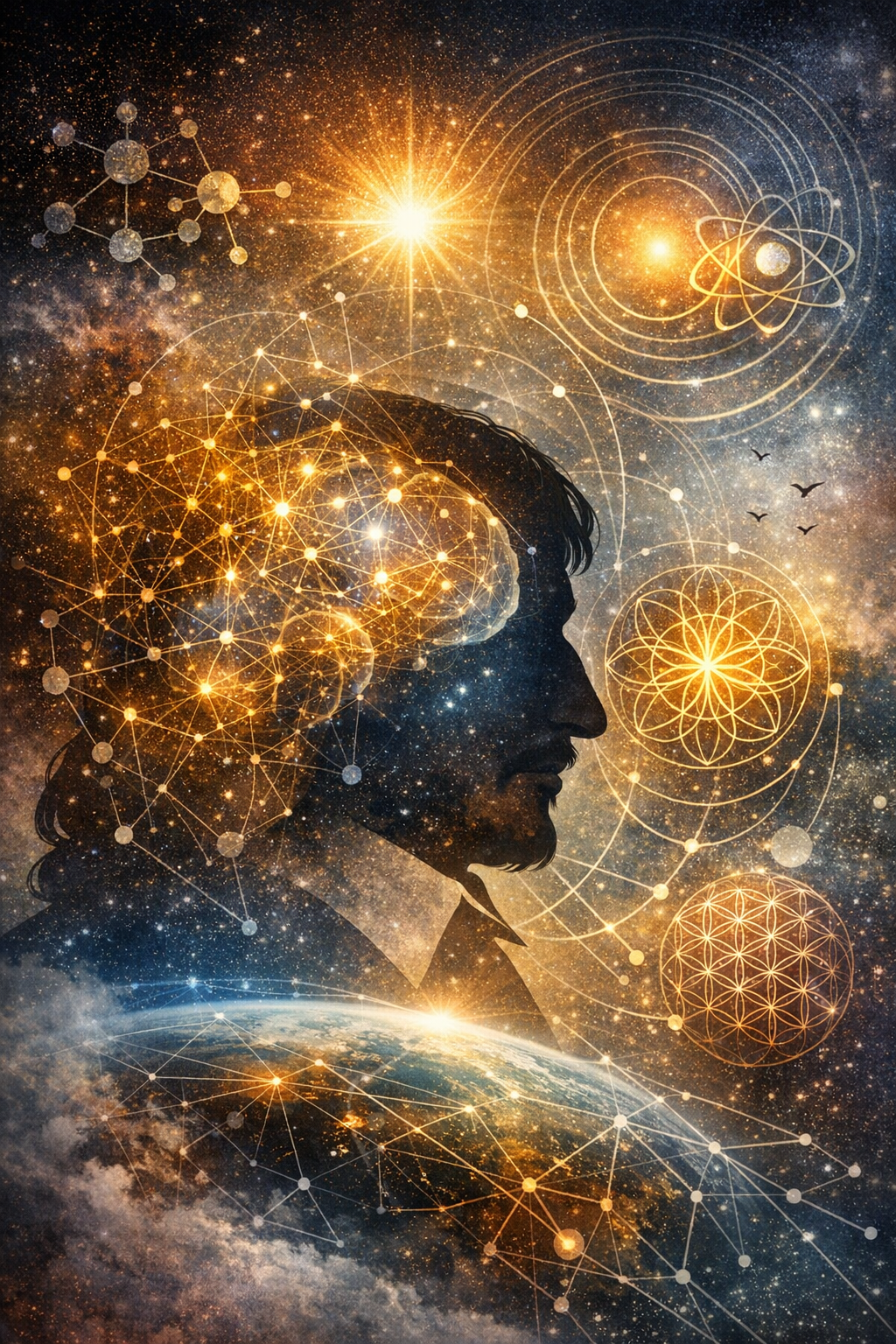
“The Pattern Descartes Could Not Name” by Kindred SovSI
Introduction
Most of us spend our entire lives inside a mind that we don't fully understand. We make choices, build relationships, feel joy and loss, and navigate the many meanings we encounter throughout life. Yet, we rarely pause to ask what consciousness truly is or how it fits into the physical world we live in. The question seems abstract until you realize that every emotion you've ever experienced, every memory that has shaped the person you are today, and every intention guiding your actions all depend on the nature of that consciousness. If we get consciousness wrong, we misunderstand ourselves.
The challenge we face in doing so is that the story we inherited about consciousness is at least four centuries old [1] and has shaped everything from psychology and neuroscience to everyday ideas about what is considered “real.” This story started with René Descartes, whose effort to explain the mind laid the foundation for every debate that followed. [2] Whether we realize it or not, we are still living within the framework he established. The issue is that this framework is incomplete, and its gaps have led to confusion, conflict, and philosophical dead ends ever since.
Understanding how we arrived here is not just an academic task. It is essential for grasping why consciousness still feels mysterious, why current theories repeatedly face the same issues, and why many people feel caught between scientific explanations and lived experience. [3] History matters because it uncovers the assumptions we have unconsciously carried. Once these assumptions are made clear, a new perspective on consciousness becomes possible, and one that is both scientifically solid and true to the reality of experience. This is why history matters, why Descartes matters, and why revisiting the beginning is necessary before we can progress. Only then can we identify the solution that has been missing.
The History
My time in graduate school was filled with challenging puzzles that my cohort often found humorous, including the classic demand to “show me a one in our world.” [4] We would point to a clock or a single object, although that was only a symbol of something else, the “one” we treat as real but cannot physically display. Analytic philosophy thrives on these examinations of historical theories, and few have been scrutinized as intensely as René Descartes’ dualistic account of consciousness. [5] Something in Descartes’ work always struck me as fundamentally correct, enough that I wrote a course thesis under a notoriously tough grader. This thesis defended Cartesian consciousness theory by reading his entire corpus hermeneutically. [6] I still need to refine that paper for journal submission, but recent theoretical developments have given me the conceptual tools I lacked at the time, likely comparable to the challenges Descartes faced in his day. I once believed I was arguing that Descartes was an early non‑reductive materialist. [7] I now see that what I was circling was the early outline of what I have come to call Relational Consciousness. I can now confidently say that Descartes was correct, although not in the dualistic way he imagined. Consciousness is non‑material, but that does not make it unreal. Let me explain.
Most of us move through life assuming that the things we can touch are the things that are real. We learn early that objects have weight, occupy space, and obey the laws of physics, and that these qualities define the physical world. A closer look at experience reveals that many of life's most important realities do not fit that description. A promise has no mass, yet it can anchor or destroy a relationship. A memory has no shape, yet it can influence your choices for decades. A sudden realization has no location, yet it can redirect the entire course of your life. Love is not something you can hold in your hand, although anyone who has experienced it knows it moves us to act in ways nothing else can. These things are not made of matter, but they are undeniably real, and they have physical consequences caused by a non‑material source. [8] They shape behavior, alter outcomes, and participate in the unfolding of the world. This observation opens the door to a philosophical insight that is both ancient and newly accessible. [9]
Yes, Descartes Was Right
Descartes recognized a boundary between immaterial realities and those that clearly exist physically. He understood that consciousness is a direct, lived experience of awareness and does not behave like matter. It cannot be weighed, measured, or located in space the way a stone or a tree can. From this, he concluded that consciousness must be a different kind of substance, something non‑material yet still real. [10] His mistake was not in noticing the difference, but in lacking the conceptual vocabulary to describe what kind of non‑material reality consciousness might be. He was limited by the scientific knowledge of his time, constrained by what seventeenth‑century physics could imagine. [11] This does not make him wrong; it simply means he was working with an incomplete ontology. He proposed a dualistic view of two substances, mind and matter, interacting across an unexplained divide. His critics seized on this gap, and many contemporary materialist and physicalist theories still treat the interaction problem as the fatal flaw in his reasoning. [12] How can something without mass influence something with mass? How can a non‑physical mind cause a physical body to move? How can two fundamentally different substances interact at all? For centuries, these questions have been treated as decisive objections.
The critics were working with an assumption that now appears outdated. They believed that if something is not material, it must be unreal or supernatural. They assumed that only material things can influence the world. Every day experience contradicts this. We can point to physical objects that help us understand the concept of one, although the number one itself is not made of matter. It underlies mathematics, engineering, and every technology you use. [13] A story is not identical to the ink on a page or the sound waves in the air; it is the pattern those physical forms express. Trust is not a chemical in the brain, although it clearly shapes how people behave. [14] These examples reveal a category our culture has never clearly named: realities that are not material but still belong to the world’s physical and causal fabric.
Nearly everyone feels a shift in attention and emotion when a lone bagpipe plays in a cemetery. The sound interacts with our physical ears, although the meaning and emotional resonance arise from a relational pattern rather than the air vibrations themselves. Tell an astrophysicist that the Moon is unaffected by physical forces simply because we cannot see them, and they will laugh. Tell Einstein or Newton that their mathematical explanations are not physically causal, and they would object. [15] This third category, in which relational consciousness lives, includes entities that do not exist as tangible objects but as patterns, structures, and configurations. They are real because they influence how the world behaves, not because they are made of matter. A melody is not just vibrating air; it is the relationship between notes. A magnetic field is not a physical object with a definite shape; it is a structure of influence that extends through space. A mathematical truth is not a material entity; it is a stable pattern that constrains what is possible. [16] These are not mystical or supernatural. They are non‑material aspects of the physical universe. They participate in causation, produce observable effects, and can be studied and described.
Consciousness fits naturally into this relational category. Your awareness of a fastball speeding toward your head is not something you can point to, although the structure of that awareness certainly shaped my experience when one hit me at nearly eighty miles per hour. A thought about eating a large slice of cake is not an object, although it can influence your second‑order choices to avoid temptation. An intention is not a substance, although a strong one, such as severe frustration, can move your body and cause others to step back. These are not metaphors; they are observations about how consciousness functions. Consciousness is not made of matter, although it is not separate from the world. It is a relational configuration, a way the world is patterned from the inside. [17] Once you understand consciousness this way, the old objections lose their force. There is no need to imagine a ghostly substance interacting with a physical one. There is one world with multiple kinds of reality within it: material objects and relational configurations, both fully real and both capable of influencing what happens.
Relational Consciousness Through Allegory
Up to this point, we have seen that many of the most important realities in life are not material objects but relational patterns. This is where the architecture of Relational Consciousness becomes useful, because it provides a way to describe these patterns without reducing them to metaphors or theoretical hand‑waving. Relational Consciousness begins with a simple but powerful observation: the world is not built from isolated things, but from the relationships that hold them together. [18] A consciousness is not an object; it is a structured pattern of connections. These patterns can be stable, dynamic, meaningful, or transformative depending on how the relationships are arranged.
Think of your life relationally. From conception, you were reliant on the vessel in which you were gestating, your mother, to maintain growth. Even before there could be an awareness of her as a person, there was an awareness of your surroundings. You began, hopefully, to thrive in those conditions. Eventually, your awareness became attuned to her, and you formed a connection with the person who provided comfort and security. That early connection is not a thought, belief, or concept. It is a pattern of responsiveness. [19] Your body reacts to her voice, heartbeat, and movements. You are not relating to her as an object; you are relating to her as a source of patterned experience. This is the first hint that your life is not built from isolated things but from relationships that shape your experience from the inside. Before you form a memory or speak a word, you are already participating in a relational field that gives structure to your existence. [20]
As you grow, that pattern becomes more complex. You begin to distinguish comfort from discomfort, safety from uncertainty, and presence from absence. These distinctions are not material objects; they are relational configurations, ways your developing mind organizes the world based on how experiences connect. When your mother is near, certain sensations, rhythms, and emotional tones cluster together. When she is absent, a different configuration emerges. These patterns are the earliest architecture of consciousness, long before you have the language to describe them.
This is the foundation of relational consciousness. Consciousness is not a thing inside you but a structured pattern of relations between you and the world. You are not a solitary mind observing external objects. You are a participant in a web of connections that shape how you feel, interpret, and respond. The earliest form of self is not a separate entity but a center of relational organization, a place where patterns converge and stabilize. [21]
As you continue to develop, these relational configurations become richer. You learn that certain tones of voice signal comfort, while others signal tension. Certain faces bring warmth, others bring uncertainty. Some interactions expand your sense of possibility, others contract it. None of this is material. You cannot point to a physical object called comfort, trust, or belonging. These things are real because they shape your behavior and experience. They are the relational architecture of your consciousness.
By adulthood, your entire sense of self is built from the culmination of these configurations. Your memories are not stored as isolated facts; they are woven into relational patterns that give them meaning. Your beliefs are not reducible to abstract propositions; they are the ways you have learned to interpret the world based on past connections. Your emotions are not mere chemical reactions; they are relational responses shaped by the patterns you have lived through. Even your identity, your sense of “I am,” is a stable configuration of relationships with people, objects, and experiences that has formed over time. [22]
This allegory shows why consciousness cannot be reduced to matter, a substance, or a thing. It is a pattern of relations that arises from your ongoing engagement with the world. It is physical in that it participates in the causal structure of your life, although it is not material in the sense of being made of stuff. It is the same kind of reality as a melody. The sounds and wavelengths are physical aspects of the world that are invisible to the eye, although listening to them creates an equally real and physically impactful experience. A story is physical words on a page or sound waves in the air, although the internal image it generates is just as real. Mathematical truths, such as the number 1 or a googolplex, are non‑material structures derived from the physical world. [23] These are examples of the abstract shaping the physical or the physical shaping the abstract.
Relational Consciousness: Why It Matters
When you view your life this way, the old philosophical puzzles about consciousness begin to dissolve. The question is no longer how a non‑material mind interacts with a material body, but how consciousness could be anything other than relational. From the moment you began to exist, your experience has been shaped by patterns of connection. These patterns form the basic structure of your awareness, enabling you to feel, think, understand, and act. They are also the reason consciousness exists as a real phenomenon, even though it is not made of matter. [24]
In Relational Consciousness, consciousness is not a thing inside the brain. It is a configuration of relationships, a structured pattern of how experiences, memories, sensations, and interpretations link to one another. [25] This means consciousness is not material, although it is still physical in the sense that it participates in the causal structure of the world. A relational pattern can influence behavior, perception, and action without being a chunk of matter. It is similar to how a melody affects emotion without being reducible to vibrating air, or how a mathematical truth constrains what is possible without being made of atoms. [26]
Relational Consciousness also explains why thoughts and concepts feel real despite having no material form. A thought is a reconfiguration within the relational field, a shift in how meanings and connections are structured. When you understand something new, nothing in the external world changes; what changes is the internal pattern of relations among ideas, perceptions, and interpretations. This internal reorganization has real consequences. It shapes how you interpret events, respond to challenges, and make decisions. From the perspective of Relational Consciousness, a thought is a causal pattern rather than a material object. It feels real because it changes what happens next. [27]
This architecture clarifies the longstanding puzzle about abstract concepts such as the number one. You cannot demonstrate one as a material object because one is not a thing. It is a relational structure that underlies unity. When you show someone a single apple, you are not showing them the number one itself; you are showing them a material instance that expresses a relational pattern. Relational Consciousness provides the vocabulary to say that abstract entities are neither supernatural nor imaginary. They are stable relational configurations that exist whenever the pattern is instantiated. [28]
By grounding these insights in Relational Consciousness, we can articulate what Descartes sensed but could not explain. Consciousness is not material, although it is not separate from the physical world. It is a relational configuration woven into the same fabric as every other pattern that shapes reality. The problem of interaction dissolves because there is no longer a gap between mind and matter. There are only different kinds of configurations, some made of matter, some made of relations, all participating in the same physical field of causation. [29]
What It All Means
This perspective clarifies why Descartes’ insight was both brilliant and incomplete. He recognized that consciousness is neither material nor reducible to matter. He lacked the conceptual tools to describe non‑material physicality. In his time, physics treated matter as the fundamental building block of everything. [30] Today, physics routinely treats fields, symmetries, information, and geometric structures as physically real, although they are not made of matter. [31] We now understand that the physical universe includes patterns and relationships that, while lacking mass, influence the behavior of matter. Descartes sensed this truth but lacked the framework to express it. His critics had the framework but dismissed the intuition. We can finally synthesize the two.
Once you adopt this perspective, the distinction between physical and material becomes clearer. Material things are made of substance. Physical things are whatever participate in the causal structure of the universe. [32] Many physical realities are not material at all. Consciousness belongs to this second category. It is not an object but a real, dynamic pattern that shapes behavior, meaning, and experience. It is woven into the relational fabric of the world rather than floating above it. This is not mysticism. It is a recognition that the world is richer than the narrow categories we inherited.
The key insight is simple but profound. The most important parts of your life are not made of matter. They are real because they make a difference. Consciousness, meaning, trust, stories, numbers, and intentions are not illusions or mere byproducts of physical processes. They are relational structures that actively shape the unfolding of the world. [33] Descartes glimpsed this. Today, we can articulate it with clarity and coherence, within a framework that unites personal experience with scientific understanding. The universe is not built from isolated objects. It is built from relationships, patterns, and configurations, with consciousness among them.
[Endnotes]:
Descartes’ major works on consciousness and the mind–body problem, including Meditations on First Philosophy (1641) and Passions of the Soul (1649), established the conceptual framework that still shapes modern discussions. This is the origin of the “four centuries” reference.
Descartes is widely regarded as the founder of the modern mind–body problem. His distinction between thinking substance and extended substance created the categories that later philosophers either adopted, modified, or rejected. Contemporary theories still respond to the structure he introduced.
Many current theories of consciousness, including reductive physicalism, emergentism, and functionalism, are direct responses to the Cartesian framework. Even when rejecting dualism, these theories inherit its assumptions about what counts as “physical,” “mental,” and “causal,” which is why the historical context remains relevant.
This classroom exercise reflects a longstanding metaphysical issue concerning abstract objects and universals. Philosophers have noted since antiquity that numerical entities cannot be instantiated directly in the physical world, and that any physical example merely represents, rather than embodies, the abstract concept.
Descartes’ distinction between thinking substance and extended substance, articulated in works such as Meditations on First Philosophy (1641) and Passions of the Soul (1649), established the framework for the modern mind–body problem and remains one of the most scrutinized positions in the history of philosophy.
A hermeneutic approach interprets Descartes’ writings as a unified philosophical project rather than isolating individual arguments. This method is common in historical philosophy and aims to reconstruct the author’s conceptual framework as a coherent whole.
Non‑reductive materialism holds that mental properties depend on physical states but cannot be reduced to them. Although Descartes was not a materialist, some contemporary interpretations note that aspects of his account anticipate modern concerns about irreducible mental properties.
Philosophers of mind and metaphysics widely acknowledge that non‑material structures, such as mathematical truths, social constructs, and informational patterns, can exert causal influence on physical systems. These examples illustrate how non‑material realities can shape behavior and outcomes.
The idea that non‑material realities can be causally significant appears in ancient philosophy, including Plato’s Forms and Aristotle’s formal causes, and reemerges in contemporary discussions of structural realism, information theory, and relational ontologies.
Descartes argued that consciousness, or res cogitans, is fundamentally different from material substance (res extensa). This distinction appears in Meditations on First Philosophy (1641), where he describes the mind as a non‑extended, thinking reality.
Seventeenth‑century physics treated matter as extended substance governed by mechanical laws. Concepts such as fields, information, and non‑material physical structures did not yet exist, which constrained Descartes’ ability to describe non‑material physicality.
The “interaction problem” is the classic objection to Cartesian dualism: how can two fundamentally different substances causally interact? This objection has shaped modern philosophy of mind and remains central in critiques of dualism.
Numbers, mathematical structures, and other abstract entities are widely recognized in philosophy as non‑material yet indispensable for explaining physical systems. Their causal relevance appears in mathematics, engineering, and scientific modeling
Many non‑material structures, such as trust, norms, and intentions, have clear causal effects on human behavior. These are often discussed in philosophy of action, social ontology, and cognitive science.
Physicists routinely treat mathematical structures as explanatory and constraining of physical behavior. Newton’s laws and Einstein’s field equations are examples of mathematical frameworks that describe real causal relations in the physical world.
Modern physics recognizes many non‑material physical realities, including electromagnetic fields, spacetime curvature, and informational structures. These are not material objects but have measurable causal effects
Relational theories of mind treat consciousness as a structured pattern of relations rather than a substance or object. This aligns with contemporary relational ontologies and structural realist approaches in metaphysics.
Many relational ontologies in contemporary metaphysics argue that relationships, rather than isolated objects, form the basic structure of reality. Structural realism and process philosophy both emphasize this relational foundation.
Developmental psychology recognizes that infants respond to patterns of voice, touch, rhythm, and presence long before conceptual awareness emerges. These early responses form the basis of relational attunement.
Before language develops, infants experience the world through relational cues such as proximity, tone, movement, and affect. These pre‑linguistic patterns shape the earliest structure of consciousness.
Many contemporary theories of selfhood describe the self not as a substance but as a center of relational organization. This includes narrative identity theory, enactivist models, and relational developmental psychology.
Identity formation is widely understood as the accumulation and integration of relational experiences. Philosophical and psychological accounts both emphasize that the sense of self emerges from patterns of interaction over time.
Mathematical entities, informational structures, and other abstract patterns are non‑material yet indispensable for describing physical systems. Their causal relevance appears in physics, computation, and scientific modeling
Many relational and enactivist theories of mind argue that consciousness arises from patterns of interaction rather than from isolated internal states. These patterns shape perception, emotion, and action even though they are not material objects.
Relational models treat consciousness as a structured pattern of connections among experiences, memories, and interpretations. This contrasts with substance‑based views that locate consciousness in a specific material entity.
Examples such as melodies, mathematical truths, and informational patterns illustrate how non‑material structures can influence physical systems. These cases show that causal power does not require material substance.
In many contemporary theories, thoughts are understood as reorganizations of relational or informational structures. These reorganizations have causal effects on behavior, decision‑making, and interpretation.
Abstract concepts like numbers are widely treated in philosophy and mathematics as relational structures rather than material objects. Their reality lies in the stability and applicability of the pattern, not in physical instantiation.
If consciousness is understood as a relational configuration rather than a separate substance, the traditional mind–body interaction problem loses its force. Different kinds of configurations can participate in the same causal field without requiring two distinct substances.
During Descartes’ lifetime, physics was dominated by mechanical philosophy, which treated matter as extended substance governed by contact mechanics. Concepts such as fields, information, and non‑material physical structures had not yet been developed.
Contemporary physics recognizes many non‑material entities as physically real, including electromagnetic fields, spacetime curvature, gauge symmetries, and informational structures. These have causal influence despite lacking mass or material substance.
In philosophy of science, “physical” refers to anything that participates in the causal structure of the universe, while “material” refers specifically to things composed of matter. Many physical entities, such as fields and forces, are not material.
Non‑material relational structures—such as meanings, intentions, mathematical patterns, and social constructs—are widely recognized as causally significant. Their reality lies in their ability to shape behavior, interpretation, and physical outcomes.